top of page
London Snow
ROBERT BRIDGES
SUMMARY
The poem presents snowfall as a transformative force that temporarily changes the ordinary city into something beautiful and unfamiliar. Bridges contrasts the quiet purity of the snow with the movement, noise and routine of urban life, showing both the beauty and disruption created by nature. As the city awakens, different reactions to the snow reveal the contrast between practical adult concerns and childlike wonder. Through this temporary transformation, Bridges suggests that nature can interrupt routine and allow familiar surroundings to be seen with renewed appreciation.
THEMES
Transformation of the ordinary
Beauty and wonder of nature
Nature versus urban life
Disruption of routine
Childhood joy and innocence
Transience and impermanence
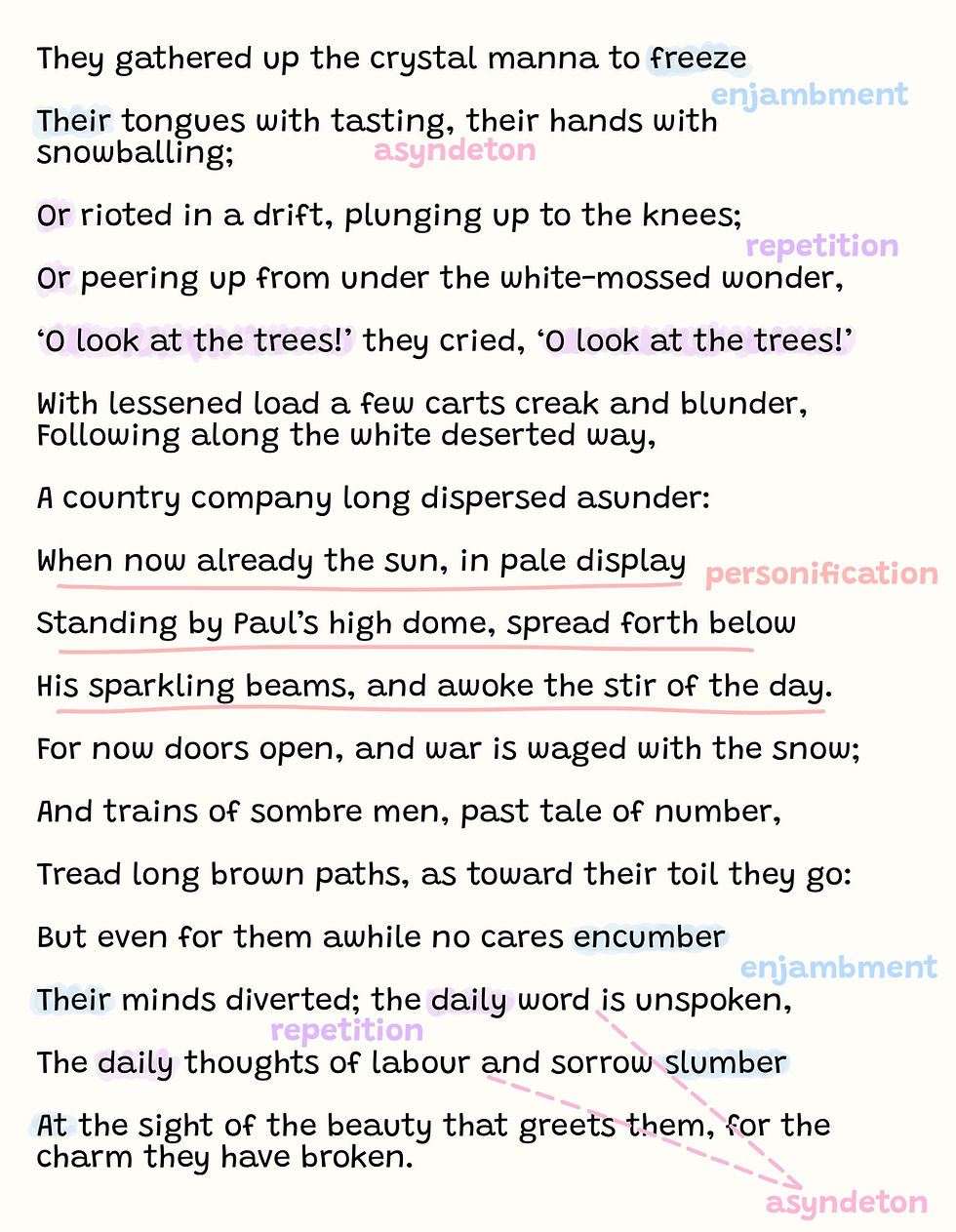
LITERARY DEVICES

TRANSLATION
While everyone was asleep, the snow began to fall,
Large white flakes came down over the brown city,
Quietly and continuously settling over everything,
Silencing the last sounds of the sleepy city.
The snow softened and muffled all its sounds,
Slowly and endlessly floating down and down,
Quietly covering the roads, roofs and railings,
Hiding the differences between things and making uneven surfaces smooth,
Softly drifting into every corner, crack and gap.
It continued falling throughout the night, until seven inches
Had settled in its loose, light layers,
Then the clouds disappeared, revealing a cold and frosty sky,
And everyone woke earlier because of the unusual brightness
Of the winter morning and its strange, almost unreal light.
Everyone was amazed by the dazzling whiteness,
And people listened carefully to the deep silence around them.
There was no sound of wheels rolling or footsteps on the ground,
And even the usual busy morning voices were quiet and faint.
Then I heard boys on their way to school calling excitedly,
Gathering the snow like a precious gift from heaven to taste it,
Freezing their tongues with it and throwing snowballs with their hands,
Or joyfully playing in the deep snow, sinking up to their knees.
Sometimes they looked out from underneath the snow-covered trees,
And shouted, “Look at the trees! Look at the trees!”
A few carts struggled slowly along the road under their lighter loads,
Following the white, empty road,
Like a group of people from the countryside who had become scattered and separated.
By then, the sun was already rising faintly
Beside the high dome of St Paul’s Cathedral,
Spreading its sparkling rays over the city and bringing the day to life.
Soon doors began to open, and people started fighting their way through the snow,
While countless serious-looking workers
Walked along the long brown paths towards their workplaces.
Yet, even for these workers, their worries disappeared for a short while,
Because the unusual beauty of the snow distracted them.
For a moment, nobody spoke about their usual daily concerns,
And their ordinary thoughts of work and sadness were forgotten,
Because they were captivated by the beauty around them,
Which had temporarily broken the routine of their everyday lives.
FORM
Continuous lyric in terza rima
METER
Irregular
RHYME SCHEME
ABA BCB CDC…
ANALYSIS & PERSONAL RESPONSE
Bridges presents the snowfall as a force capable of transforming an ordinary urban landscape into something beautiful, unfamiliar and almost magical. London, normally associated with noise, movement and human activity, is temporarily covered by snow, which softens its familiar shapes and creates an atmosphere of stillness. The snow seems to erase the city’s everyday identity and replace it with a cleaner, more harmonious version of itself. The poem therefore moves beyond simple description of winter weather: Bridges explores how nature can briefly interrupt human routine and alter the way people perceive their surroundings. The reader is encouraged to recognise that beauty may emerge when the familiar world is unexpectedly transformed, allowing ordinary places to be seen with renewed wonder.
The contrast between the purity of the snow and the crowded, practical world of London allows Bridges to explore the tension between nature and urban civilisation. The snow initially appears gentle and almost effortless as it falls during the night, yet its effects become increasingly disruptive once the city awakens. Roads, work and ordinary routines are disturbed, suggesting that the same natural force that creates beauty can also challenge human attempts at organisation and control. Bridges therefore avoids presenting the snowfall as purely idealised: its beauty exists alongside inconvenience and disorder. The reader may initially admire the perfect whiteness of the transformed city, but is gradually encouraged to recognise that nature remains independent of human needs and expectations.
Structurally, Bridges moves from quiet nocturnal transformation towards increasing human activity, allowing the poem to show how differently nature is experienced before and after the city awakens. The opening creates a peaceful sense of accumulation as the snow silently covers London, while the later sections introduce movement, voices and people responding to the changed environment. Children in particular experience the snow with excitement, contrasting with adults whose routines are disrupted by it. This movement from silence to activity makes the snowfall seem like a temporary interruption of normal urban life before everyday reality eventually reasserts itself. The reader is left with the sense that the snow creates a brief escape from routine, reminding us that moments of beauty are especially powerful because they are temporary and cannot be preserved forever.
ABOUT THE AUTHOR
Robert Bridges was a nineteenth-century English poet whose work often explores nature, beauty, human experience and the relationship between the natural world and modern civilisation. Associated with late Victorian poetry, his writing is known for its musical language, precise descriptions and carefully structured imagery, frequently combining natural observations with philosophical reflections to examine the complexities of human existence. Bridges's poetry often explores the restorative influence of nature upon humanity, presenting the natural world as a source of beauty, harmony and emotional renewal amidst the pressures of everyday life. In London Snow, Bridges explores the relationship between natural beauty, urban existence and human consciousness, suggesting that nature possesses a transformative power capable of temporarily overcoming the monotony, divisions and responsibilities of modern society.
The poem demonstrates Bridges's interest in the tension between natural tranquillity and urban activity, particularly the ways in which unexpected natural beauty can interrupt the routines of human existence. Through the imagery of falling snow, the transformed city, the playful children and the returning workers, Bridges presents different perspectives on wonder, innocence and the temporary suspension of everyday responsibilities. The imagery of whiteness, silence and gentle movement suggests that nature possesses a unifying power capable of concealing the imperfections of urban existence, while the references to children's excitement and collective admiration reveal its ability to inspire spontaneous joy and emotional liberation. However, the poem's concluding return to labour and the gradual destruction of the snow's untouched beauty complicates the idealisation of nature, suggesting that its transformative influence remains temporary within the demands of modern civilisation. The poem therefore moves beyond a conventional celebration of winter scenery and becomes a meditation on beauty, transience and the enduring tension between natural harmony and human responsibility.
SOCIAL CONTEXT
The poem can be understood within the context of late Victorian society, a period characterised by rapid industrialisation, urban expansion and significant changes to everyday life in Britain. By the late nineteenth century, London had developed into a major industrial and commercial centre, where increasing population density, pollution and demanding working conditions shaped the experiences of its inhabitants. Published in 1890, London Snow reflects these concerns through the contrast between the city's ordinary appearance and its temporary transformation under a blanket of snow. The imagery of the brown city becoming covered in dazzling whiteness suggests that nature possesses the power to conceal the physical and emotional consequences of industrialisation, while the sudden silence contrasts with the constant noise and movement associated with urban existence. The poem therefore explores the tension between the pressures of modern city life and the restorative influence of the natural world, suggesting that beauty and tranquillity can provide temporary relief from the demands of an increasingly industrialised society. Bridges draws attention to the contrast between human activity and natural processes, presenting nature as a force capable of transforming even the most familiar and heavily developed environments.
The poem also reflects the social and economic inequalities of Victorian Britain, particularly the demanding conditions experienced by the urban working population. Industrialisation had created opportunities for economic development, but it also contributed to long working hours, difficult living conditions and the repetitive routines associated with wage labour. Bridges explores these realities through the image of workers returning to their daily responsibilities after the snowfall, presenting their movement through the city as a collective struggle against the temporary disruption caused by nature. The contrast between the children's joyful response to the snow and the adults' obligation to continue working highlights the differing experiences of freedom and responsibility within society. However, the snow briefly interrupts these distinctions, offering individuals from different backgrounds a shared experience of wonder and tranquillity. The snow's ability to conceal physical differences within the landscape can also be interpreted as a symbolic representation of social equality, suggesting that nature temporarily obscures the divisions created by human society. Bridges therefore draws attention to the tension between the inequalities and responsibilities of everyday existence and the universal human capacity to appreciate beauty, suggesting that moments of collective happiness can briefly transcend social and economic boundaries.
The poem can also be read within the context of the Romantic literary tradition, which continued to influence Victorian writers through its emphasis on nature, imagination and the emotional significance of ordinary experiences. Romantic poets frequently presented the natural world as a source of spiritual renewal and emotional freedom, contrasting its beauty and spontaneity with the restrictions imposed by industrial civilisation. Bridges reflects these conventions through his detailed descriptions of the snowfall, transforming an ordinary weather event into an experience of collective wonder and temporary liberation. The children's spontaneous excitement represents an instinctive appreciation of nature, while the adults' brief escape from their anxieties suggests that the capacity for wonder remains present even within the routines of modern life. However, Bridges complicates the Romantic idealisation of nature by emphasising the temporary nature of this transformation, as the arrival of daylight and the resumption of human activity gradually destroy the snow's untouched beauty. The image of people breaking paths through the snow suggests the inevitable return of human intervention, responsibility and social order. Bridges therefore explores the tension between the permanence of society's demands and the fleeting nature of beauty, suggesting that moments of tranquillity cannot completely overcome the pressures of human existence. The poem ultimately presents nature as a source of temporary renewal, encouraging individuals to recognise the emotional and spiritual value of beauty even when its effects cannot be preserved indefinitely.
SAMPLE QUESTIONS
How does Bridges strikingly convey the effects of snow on London in 'London Snow'?
ANSWERING TIPS
-
Explore the transformation of London
-
Analyse imagery and sound
-
Consider the people's response
How, and with what effects, does Bridges use language and imagery to present the experience of snowfall in 'London Snow'?
ANSWERING TIPS
-
Explore sensory imagery
-
Analyse contrasts
-
Link imagery to wider ideas
bottom of page